From Archives to Algorithms: My Research Stay at Masaryk University


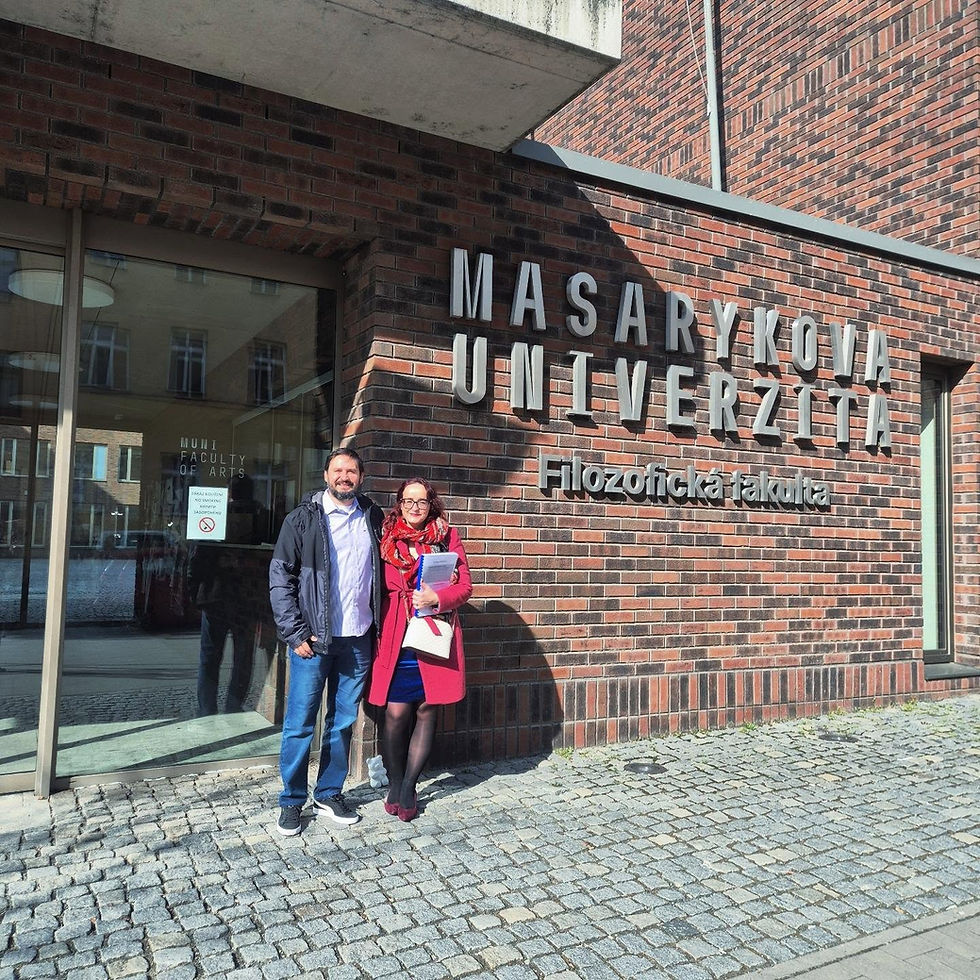
In March 2026, I had the pleasure of participating in a research stay at the Masaryk University, hosted by the Department for the Study of Religions and the Centre for Digital Research of Religion. From March 23 to 27, the visit offered a stimulating environment for scholarly exchange and interdisciplinary discussion.
The stay was made possible by an invitation from David Zbíral, principal investigator of the ERC-funded DISSINET Project. His work on dissident networks and digital methods in historical research is inspiring, and it was a privilege to engage directly with his team.
As part of the visit, I gave a talk titled “From Archives to Algorithms: Digital Methods for Studying Imperial Commoners of Brazil and West Africa (1640–1822).”
The presentation explored how digital and AI-assisted methods can expand the study of imperial commoners in the Portuguese Empire. Using case studies from the Portuguese Overseas Historical Archives, I demonstrated how computational approaches – such as Named Entity Recognition, Sentiment Analysis, Topic Modeling, and large language models – allow researchers to process and analyze extensive archival collections that would otherwise require decades to review manually. A central point of my talk was that artificial intelligence does not replace historians; it transforms their role. Historians remain responsible for curating datasets, defining conceptual categories, interpreting findings, and validating algorithmic outputs. Rather than diminishing historical scholarship, AI reinforces the importance of domain expertise while shifting historians’ work toward designing research questions and overseeing computational processes. However, applying digital methods to early modern archival materials presents significant challenges, including OCR errors and noisy textual data, linguistic variation across regions and time periods, limited annotated datasets, and structural biases in digital corpora. These issues are especially pronounced for African archival materials, where languages and historical vocabularies are underrepresented in digital infrastructures.
This research stay was intellectually rewarding, emphazising the importance of interdisciplinary collaboration. It reaffirmed that the future of historical research relies on combining traditional archival expertise with innovative computational methods. Integrating archives and algorithms is not merely a methodological shift; it is a way of rethinking our approach to the past.


Mình đọc mấy bài soi cầu cũng kha khá thời gian rồi, coi như thêm một kênh tham khảo chứ không bao giờ dám đặt niềm tin tuyệt đối. Hồi trước toàn chọn theo cảm giác, trúng thì hớn hở mà trượt thì cáu, nên sau này mình chuyển sang ghi chú lại những cặp hay xuất hiện rồi tự xem nhịp về của chúng. Có lần lướt thấy Soi cầu Atrungroi phân tích theo kiểu lô gan với cầu lặp, cách diễn giải khá dễ nắm nên mình thử làm theo, chọn ít số và đánh nhỏ để thử cho chắc. Có bữa thấy ổn, có bữa lại không ăn thua, nhưng được cái mình đỡ bị cảm xúc…